Oct 28, 2026Blogs
How to Choose the Right Forklift Fork Extensions (Fork Slippers)
Learn how to choose the right forklift fork extensions for long or bulky loads. Compare FE vs. EX types, sizes, capacities, and safety tips — a complete buyer's guide.
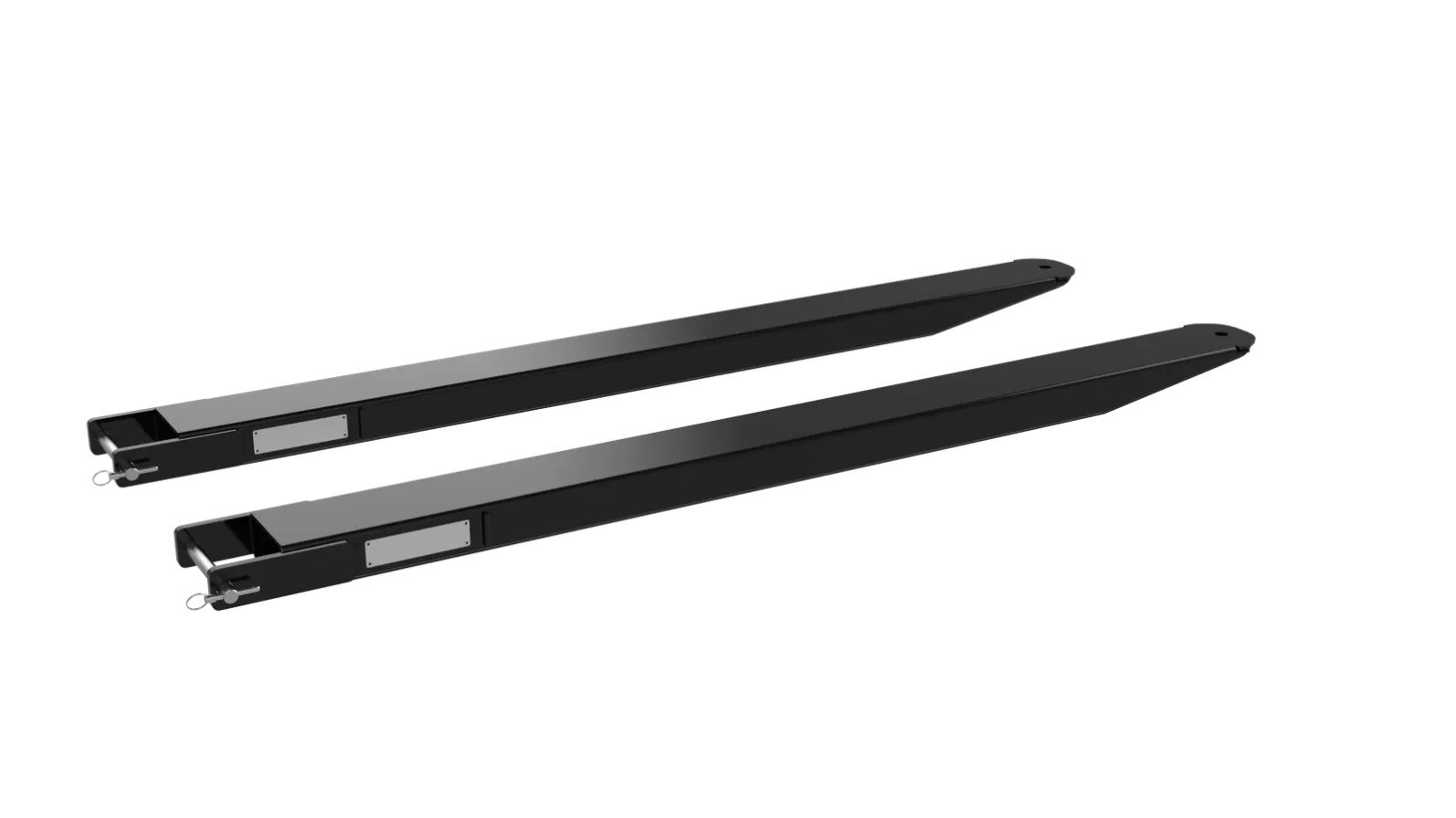
Forklifts are built for versatility, but the standard fork length on most trucks — typically 1,070 mm (42 in) or 1,220 mm (48 in) — is simply not enough for every job. When you need to handle timber, steel pipes, carpet rolls, furniture, or other long and bulky loads that overhang the forks, forklift fork extensions (also called fork slippers or fork sleeves) are one of the most cost-effective attachments you can buy.
But choosing the wrong size or type can compromise safety, damage your load, or even breach workplace safety regulations. In this guide, we'll walk you through exactly how to choose the right fork extensions for your forklift, your loads, and your budget.
What Are Fork Extensions and When Do You Need Them?
Fork extensions are steel sleeves that slide directly over your existing forks, extending their reach so the load is supported along more of its length. They're designed and manufactured in accordance with AS2359.15, the Australian standard for fork arms and fork extensions.
You need fork extensions when:
- Your loads are long and tend to overhang the standard forks — such as timber, pipes, conduits, or extrusions
- You handle bulky but light materials like furniture, mattresses, carpet rolls, or packaged goods
- You want extra load stability without investing in a longer-fork forklift or a second truck
A critical rule before anything else: the length of the fork extensions used for general usage shall not exceed 160% of the supporting fork tine's length. For example, if your forks are 1,220 mm long, your extensions should be no longer than about 1,950 mm. Exceeding this ratio shifts the load center dangerously far forward and drastically reduces your truck's effective lifting capacity.
Step 1: Measure Your Existing Forks
Fork extensions slide over your forks like a sleeve, so a precise fit is essential. You need three measurements:
- Fork width (W) — measure across the face of the fork
- Fork thickness (H) — measure the vertical thickness of the fork
- Fork length — to make sure your chosen extension length stays within the 160% rule
Always choose an extension with an internal cross-section slightly larger than your fork dimensions. For example, our FE series extensions with a 110 × 50 mm internal opening fit forks up to 100 × 45 mm, while the EX1 series with a 120 × 50 mm opening also accommodates forks up to 110 × 45 mm. A slightly loose fit is normal and safe — a fit that's too tight simply won't install.
Step 2: Choose the Right Type — Closed-Bottom vs. Open-Bottom
Fork extensions come in two structural types, and the choice affects both capacity and convenience:
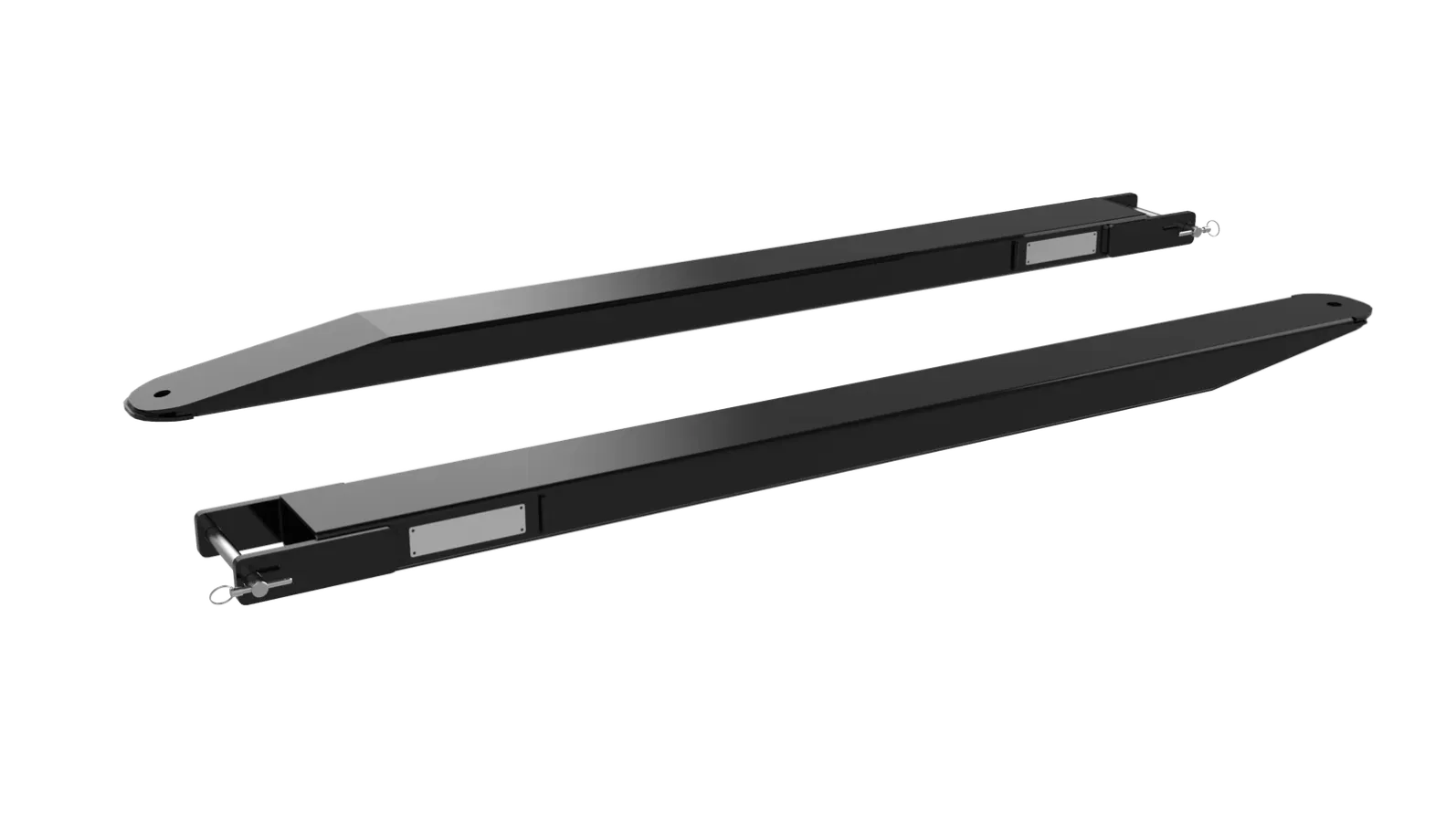
Closed-bottom (FE series) — the top face of the fork is fully covered by a continuous steel plate, with the sleeve only open underneath. This design offers maximum strength and load capacity, making it the right choice for heavy-duty applications, harsh environments, and higher-capacity forklifts (3,000 kg to 8,500 kg rated pairs).
Open-bottom (EX series) — both the top and bottom of the sleeve are open along the fork. This makes installation and removal even faster and keeps weight down, which is ideal for lighter duty cycles, frequent swapping between trucks, and capacity classes up to 4,000 kg.
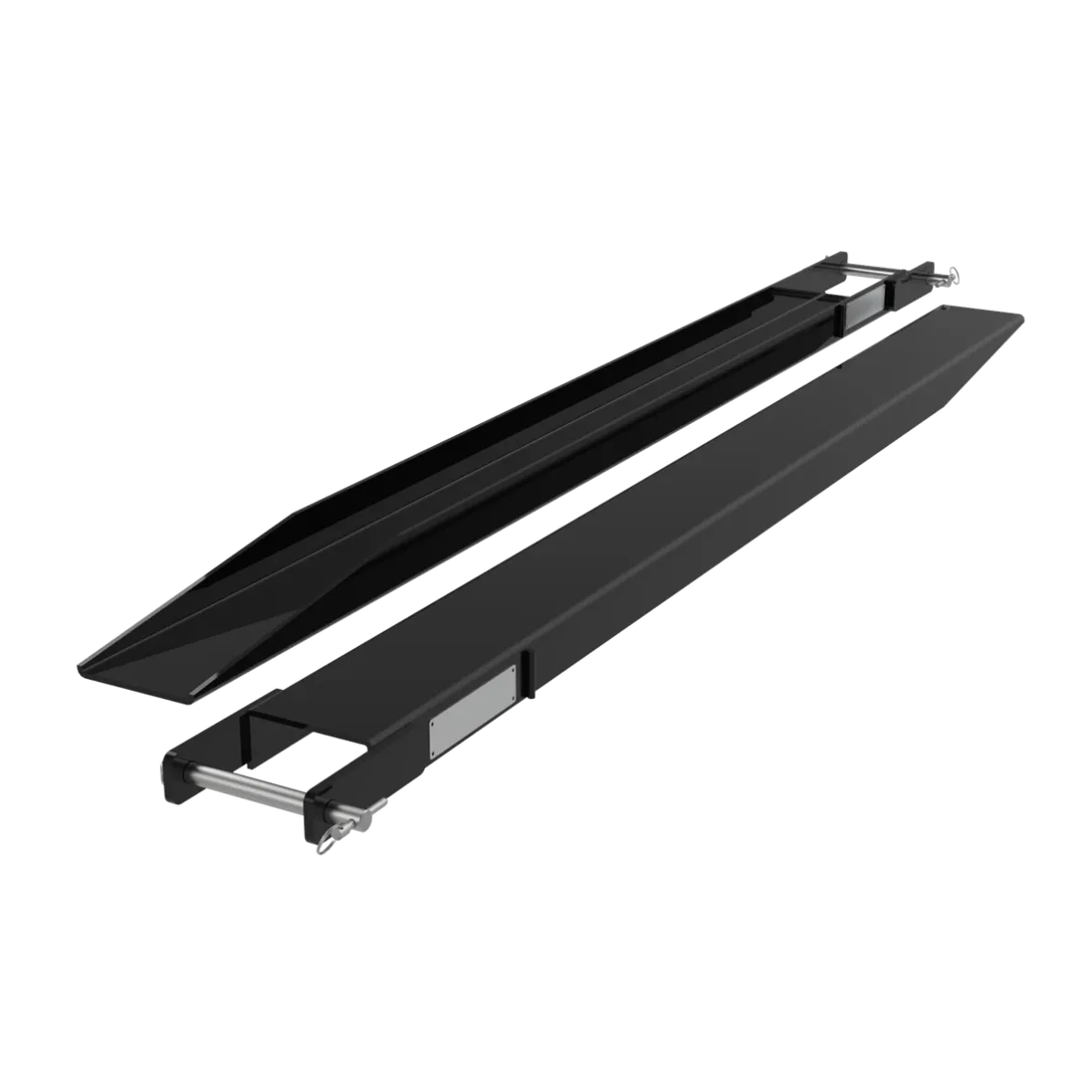
As a rule of thumb: if you lift heavy steel, timber, or machinery regularly, choose closed-bottom; if you occasionally handle long, light loads and value convenience, open-bottom will serve you well.
Step 3: Match the Capacity to Your Load
Every fork extension model has a rated capacity per pair at a 600 mm load center — and it is always lower than your forklift's rated capacity, because the extension adds leverage and its own weight.
Series | Type | Capacity Range (per pair) | Max Fork Size | Plate Thickness |
|---|---|---|---|---|
FE1 | Closed-bottom | 3,000 kg | 100 × 45 mm | 6 mm |
FE2 | Closed-bottom | 4,500 kg | 130 × 50 mm | 6 mm |
FE3 | Closed-bottom | 6,500 kg | 150 × 55 mm | 8 mm |
FE4 | Closed-bottom | 8,500 kg | 165 × 65 mm | 8 mm |
EX1 | Open-bottom | 2,000 kg | 110 × 45 mm | 6 mm |
EX2 | Open-bottom | 3,500 kg | 120 × 50 mm | 6 mm |
EX3 | Open-bottom | 4,000 kg | 140 × 50 mm | 6 mm |
Three capacity rules to follow:
- Never exceed the extension's rated capacity, even if your forklift could technically lift more
- Remember the load center: ratings assume a 600 mm load center. Longer loads shift the center of gravity forward and reduce real-world capacity
- Factor in the added weight of the extensions themselves (37–186 kg per pair depending on model) when calculating your truck's residual capacity
When in doubt, choose the next size up in capacity — the price difference is small compared to the cost of an accident.
Step 4: Select the Right Length
Fork extensions are commonly available in 1,600 mm, 1,800 mm, 2,100 mm, 2,400 mm, and 3,000 mm lengths. Use this simple logic:
- Measure the longest load you handle regularly
- The goal is to support at least two-thirds of the load's length
- Apply the 160% rule against your fork length as the hard ceiling
For example, handling 3-meter timber with 1,220 mm forks? The 160% ceiling is ~1,950 mm, so 1,800 mm extensions are the correct choice — the 3,000 mm option would be non-compliant for general usage with those forks.
Step 5: Consider Material, Finish, and Working Environment
Quality fork extensions are made from heavy-duty heat-treated steel, which resists bending and cracking under repeated loads. Surface treatment matters too:
- Galvanized finish — best for outdoor use, humid climates, cold storage, food and chemical environments where corrosion resistance is critical
- Painted finish — a cost-effective option for clean, indoor warehouse applications
All quality extensions should be supplied with toggle locking pins that lock the sleeve onto the fork heel. Never use extensions without a positive locking mechanism — an unsecured sleeve can slide off the fork tip, with the load still on it.
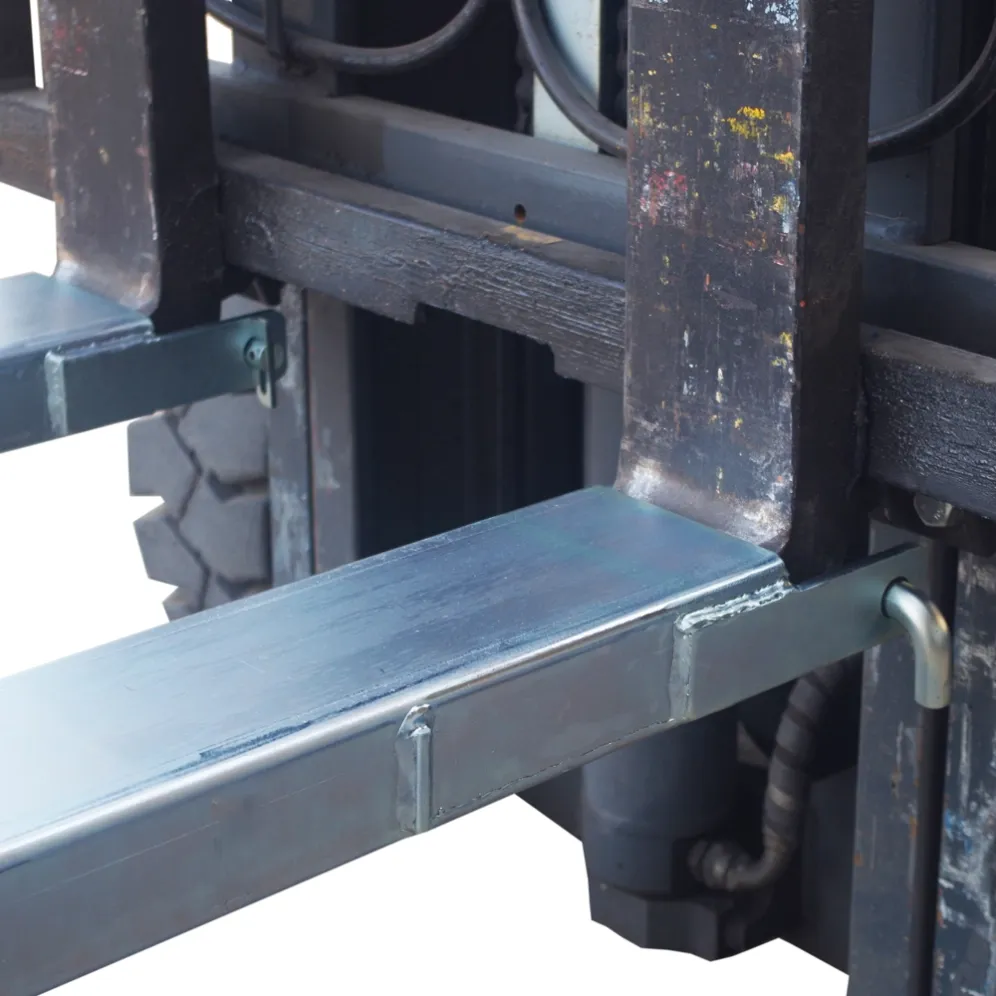
Step 6: Installation and Daily Safety Checks
One of the biggest advantages of fork slippers is that installation takes seconds:
- Park the forklift with the mast vertical and forks lowered to the ground
- Slide each extension over the fork with the locking pin opening at the heel
- Secure the toggle locking pins fully
- Before every shift, visually confirm both pins are engaged and there are no cracks or deformation
Operator tip: with extensions fitted, drive slower, keep the load as low as possible, and brake gently — extended forks amplify any load swing.
Common Mistakes to Avoid
- Buying extensions longer than needed — longer isn't better; it's a capacity and compliance risk
- Ignoring fork dimensions — guessing instead of measuring leads to returns and downtime
- Overlooking load center ratings — a "3-ton" extension at 600 mm load center is not a 3-ton extension at 900 mm
- Skipping the locking pins — the single most common cause of extension-related incidents
- Using extensions to compensate for overload — extensions add support for long loads, but they never increase what your forklift can legally lift
Fork Extensions vs. Longer Forks: Which Should You Choose?
If you permanently handle long loads every day, replacing your forks with longer ones may be worth the investment. But for most operations, fork extensions win:
- Cost — a pair of extensions costs a fraction of new fork arms plus fitting
- Flexibility — remove them in seconds when you need the standard forks back
- Availability — no need to wait for a service technician to change forks
- Fleet sharing — one pair can serve multiple trucks of the same fork size
Frequently Asked Questions
Q: How much longer than my forks can fork extensions be?
A: For general usage, extension length should not exceed 160% of the supporting fork's length. Check this before ordering.
Q: How do I know which model fits my forks?
A: Measure your fork width and thickness, then choose a model whose maximum fork size matches. For example, forks up to 100 × 45 mm fit the FE1 series; forks up to 150 × 55 mm fit the FE3 series.
Q: Can I use one extension instead of a pair?
A: No. Fork extensions must always be used as a matched pair to keep the load balanced and within the rated capacity.
Ready to Order?
TDJ fork extensions are manufactured to AS2359.15 in both closed-bottom (FE) and open-bottom (EX) types, with seven series covering capacities from 2,000 kg to 8,500 kg and lengths from 1,600 mm to 3,000 mm — all supplied with toggle locking pins and available in galvanized or painted finish.
Not sure which model fits your forks? Contact our team with your fork dimensions and typical load, and we'll recommend the right extension in one business day.