Sep 9, 2026Blogs
The Ultimate Guide to Choose the Right Forklift for Your Business
Forklifts are widely used in many enterprises and factories. Here's your step-by-step guide to choose the most suitable forklift.
Selecting the right forklift is about more than just lifting capacity. From indoor electric models to outdoor diesel workhorses, and critical safety certifications like CE and ISO 3691, here’s the guidance to make the right investment.
Why the Right Choice Matters
Investing in a forklift is a significant capital expense. Choosing the wrong model can lead to inefficiency, safety hazards, and unexpected compliance costs - especially when importing equipment across borders.
Whether you are expanding your warehouse or upgrading your fleet, this guide will walk you through the four essential steps to select the perfect forklift for your operation.
Step 1: Define Your Operational Profile
Before you look at any specification sheets, ask yourself and your team these three fundamental questions:
- What are you lifting?
- Determine the maximum load weight in tons or kilograms. Always leave a 10–15% safety margin above your heaviest regular load.
- How are you using it?
- Will it be used purely for horizontal transport, or do you need to stack goods onto high racking?
- Where are you using it?
- Indoors (smooth concrete floors) or outdoors (gravel, slopes, or uneven terrain)?
- How wide are your warehouse aisles? Tight spaces require smaller turning radius.
Step 2: Match the Application to the Right Forklift Type
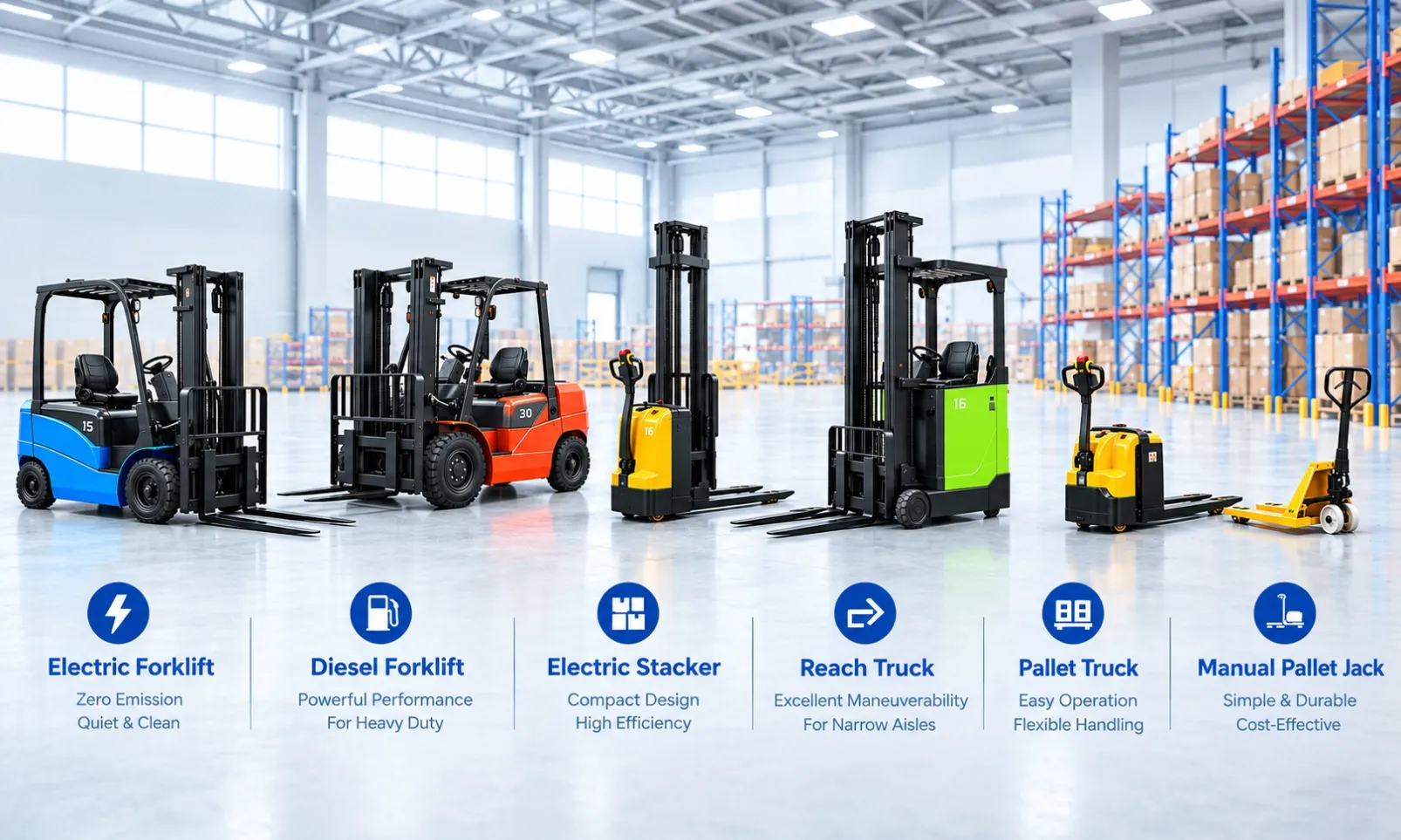
Based on your answers, here is a clear breakdown of the most common forklift types and their ideal use cases:
Forklift Type | Best For | Key Features |
|---|---|---|
Electric Pallet Jack | Light-duty, flat-floor horizontal transport | Compact, affordable, great for loading/unloading trucks. |
Electric Stacker | Low-to-mid height stacking (up to 5m) in narrow aisles | Ideal for small warehouses; requires less aisle width than counterbalance trucks. |
Reach Truck | High-bay warehousing with very narrow aisles | Extendable forks allow for deep racking; maximum space utilization. |
Counterbalance Forklift | The most versatile workhorse for loading/unloading and stacking | Available in electric (indoor) and internal combustion (outdoor) versions. |
Tow Tractor | Long-distance horizontal towing of multiple carts | No lifting; perfect for assembly lines or large factory floors. |
Electric vs. Internal Combustion (The Power Debate)
- Electric (Lithium-Ion preferred): For indoor use. Zero emissions, low noise, and modern lithium-ion batteries offer fast charging and maintenance-free operation. This is the global trend for sustainability.
- Internal Combustion (Diesel/LPG): For outdoor, heavy-duty, or multi-shift operations where recharging is impractical. Better for rough terrain and heavier loads.
Step 3: The "Non-Negotiable" - Safety & Export Compliance
This is the most critical part of the selection process, especially if you are importing machinery internationally. Do not skip this.
1. CE Certification & ISO 3691 Standards
For equipment entering the European market, the forklift must carry a CE mark(Machinery Directive compliance). Verify that the manufacturer’s certification is issued by a reputable body (e.g., TÜV Rheinland). Moreover, ensure the equipment meets ISO 3691 series standards—the international safety benchmark for industrial trucks, covering braking, stability, and control systems.
2. Emission Compliance – A Regional Must-Have
If you are considering an internal combustion (diesel, LPG, or gasoline) forklift, emission regulations vary significantly by country and region.
- Europe: The EU enforces Stage V emission standards (Regulation (EU) 2016/1628), which impose strict limits on particulate matter (PM) and nitrogen oxides (NOx) for non-road mobile machinery.
- United States: The EPA (Environmental Protection Agency) and CARB (California Air Resources Board) have their own stringent tiers (e.g., Tier 4 Final). California has particularly aggressive requirements; many states follow CARB rules, so verify the destination state.
- Other Markets: Some emerging markets still allow older, less restrictive standards, while others (like Japan, Korea, and Australia) are increasingly aligning with Euro standards.
Action point: Always request and confirm the machine matches the destination country's current legal requirements. For hassle-free global shipping, many customers are now shifting to lithium-ion electric forklifts to bypass emission concerns entirely.
3. Shipping Lithium-Ion Batteries (Dangerous Goods)
If you opt for a lithium-ion model, note that they are classified as UN 3556(Vehicles powered by lithium batteries) under the latest IMDG Code (42-24 edition). You must work with a freight forwarder experienced in handling dangerous goods to ensure proper packaging and declarations.
Step 4: The Technical "Must-Have" Specs
Once you have the type and compliance sorted, drill down into the final technical data to ensure the machine physically fits your workplace:
- Minimum Turning Radius: The smaller the number, the more agile the truck in tight corners.
- Aisle Width (Right-Angle Stacking): Ensure this number is less than your current warehouse aisle width.
- Maximum Lift Height: Must reach your highest racking shelf, with extra mast travel for smooth engagement.
- Free Lift Height (Crucial for Container Loading/Unloading): If your forklift needs to enter shipping containers, trailers, or low-clearance spaces, full free lift mast (FFL) is non-negotiable. Free lift refers to the height the forks can rise without increasing the overall height of the mast. Without sufficient free lift, the mast will hit the container ceiling before the forks can raise the load off the floor.
- Load Center Distance: Standard is 500mm for 1 to 5 ton trucks. If your load’s center of gravity is further forward, reduce the rated capacity accordingly.
Final Checklist for Your Purchase Decision
Before you sign the purchase order, run through this quick checklist with your supplier:
- □ Does the machine have valid CE and ISO 3691 certificates?
- □ Does the machine meet the Emission Standard?
- □ Is the battery type (Lead-acid or Lithium-ion) suitable for your shift schedule?
- □ Are spare parts and after-sales service readily available in your region?
- □ Have you confirmed the shipping classification (especially for UN 3556)?
Conclusion: Invest Wisely, Operate Safely
Choosing a forklift isn't just about moving boxes; it’s about moving your business forward efficiently and legally. By following this guide, you are not just buying a machine - you are making a strategic investment in productivity and safety.
Wish you success in getting the right forklift that fits your budget, operation, and local regulatory requirements.