Oct 22, 2026Blogs
How to Choose the Right Forklift Forks: A Practical Guide for Safety and Efficiency
Whether you are specifying forks for a new application, replacing a worn set, or managing a mixed fleet, this guide covers the essential factors to get the selection right.
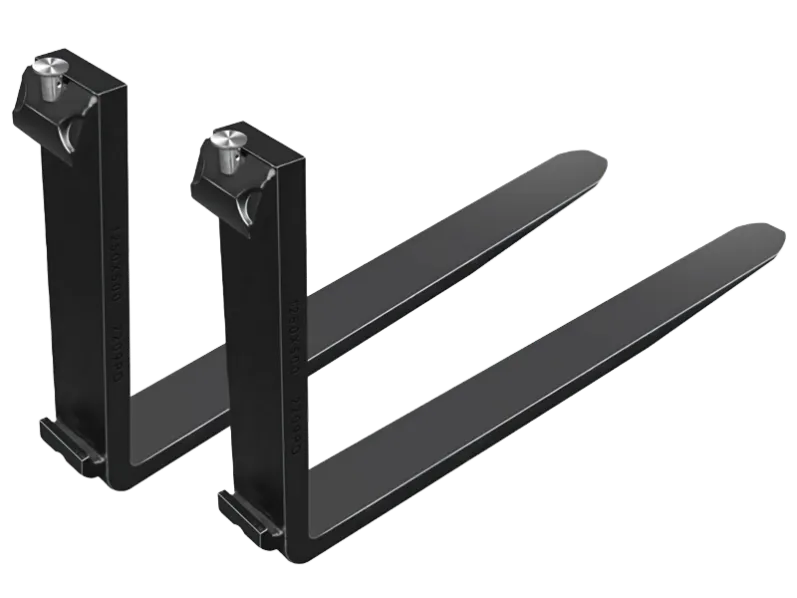
Forklift forks may look like a simple component, but they are the critical interface between your equipment and the load. Choosing the wrong set can lead to load instability, premature wear on the truck, reduced productivity, and serious safety hazards. In fact, a mere 10% reduction in fork thickness due to wear can decrease lifting capacity by 20%, which is why OSHA requires forks worn beyond that threshold to be removed from service and destroyed.
Whether you are specifying forks for a new application, replacing a worn set, or managing a mixed fleet, this guide covers the essential factors to get the selection right.
Start with the Carriage Class, Not the Fork Alone
Forks are not universally interchangeable. The first checkpoint is the carriage class, which determines whether the fork hooks will engage the carriage bars correctly and lock safely.
Hook-style forks follow standardized ITA classes based on carriage height and truck capacity. Class II forks typically fit 16-inch carriages on trucks up to about 5,500 lbs, Class III fits 20-inch carriages for roughly 5,500 to 11,000 lbs, and Class IV fits 25-inch carriages for higher-capacity trucks. A fork that appears close in size but belongs to the wrong class may not seat or lock properly, creating a risk of the fork sliding or disengaging under load.
If your operation uses pin-mounted, bolt-on, or shaft-style forks, the mounting method must match exactly. These are not interchangeable with standard hook forks and often require application-specific ordering.
Match Capacity to the Load Center, Not Just the Weight
Fork capacity is rated for a pair at a specified load center, usually 24 inches. The load center is the horizontal distance from the fork face to the center of gravity of the load. If you handle loads with a deeper center of gravity—long crates, double-stacked pallets, or bulky equipment—the effective capacity of the forks decreases even if the total weight is within the nominal rating.
A common mistake is assuming that forks from a 5,000 lb truck can safely handle a 6,000 lb load. They cannot. Forks must be rated for the load they will actually carry, and the forklift’s data plate remains the final limit. Installing heavier-rated forks does not increase the capacity of the truck itself.
Choose the Blade Length for Stability, Not Maximum Coverage
There is a persistent misconception that forks should be as long as the load. In practice, forks need to support only about 75% of the load depth for stable handling. Overly long forks introduce real risks: they can strike racking behind the load, damage product on adjacent pallets, or create a tripping hazard for pedestrians.
For most standard pallet handling, a fork length that supports the pallet depth with a modest margin is sufficient. For specialized applications—such as handling long lumber or double-deep racking-longer forks may be justified, but the trade-off in maneuverability and clearance must be considered.
Consider Taper and Tip Design for Your Application
The shape of the fork blade affects how easily it slides under loads and how well it retains them.
A standard taper, which gradually narrows toward the tip, is the most versatile choice for general pallet handling. Full-taper polished forks reduce friction and are useful for sliding under flat materials or tight pallet openings. For rugged outdoor or construction environments, unpolished full-taper forks offer durability without the cost of polishing.
Fork tips matter as well. Square tips provide a robust, flat edge for standard applications. Round tips are designed for smoother entry into pallets and are gentler on delicate or tightly packed materials.
Specialized Operations Require Specialized Forks
If your operation handles more than standard pallets, the fork selection should reflect that. Common specialty options include:
- Lumber and plywood forks with finely tapered tips for easier entry into stacked material
- Block forks designed for handling bricks and masonry
- Coil handling forks with contoured blades for cylindrical loads
- Spark-retardant forks, often brass-covered, for hazardous environments
- Folding forks for tight spaces where maneuverability is constrained
Using a general-purpose fork for a specialized task is a compromise that affects both safety and efficiency. If the load does not fit the standard pallet profile, the fork should be matched to the load.
Inspection and Replacement: The Ongoing Responsibility
Selection is only the first step. Forks wear with every lift, especially at the heel where the blade meets the shank. Daily visual checks should look for cracks, permanent distortion, and excessive wear. A thorough inspection by a trained individual should occur at least every six months, checking heel wear, fork tip height variation (which should not exceed 3% of blade length), and the 90-degree fork angle.
Forks should always be replaced in pairs. Mixing a new fork with a worn one creates uneven load support and puts stress on the mast and carriage. Field repairs, welding, or drilling are never acceptable—these modifications destroy the heat treatment and compromise the fork’s structural integrity.
The Bottom Line
Choosing the right forklift forks comes down to four questions: Does the mounting class match the carriage? Is the capacity rated for the actual load center? Is the blade length appropriate for the load without being excessive? And does the taper and tip design suit the material being handled? Getting these right protects your operators, extends equipment life, and keeps material flow efficient. When in doubt, consult your forklift or fork manufacturer with the truck’s model, carriage class, and load specifications on hand—the few minutes spent verifying compatibility are far cheaper than a dropped load.